

Eagle population grows in Licking County
2025 survey by the ODNR shows 20 nests in the county and 1,009 statewide
When the United States celebrated its bicentennial 50 years ago, in 1976, bald eagles — America's national bird — were scarce. In 1979, according to the Ohio History Connection, just four nesting pairs of eagles remained in the state.
After decades of conservation efforts, though, bald eagle populations have skyrocketed, with active nests confirmed in 87 of Ohio's 88 counties last year.
As the foliage thickens and trees begin to leaf out, visible eagle nests in Ohio will soon be covered by leaves. Peak viewing season is coming to an end, but there's still a chance to see these birds across the state.
In 2025, the Ohio Department of Natural Resources' Division of Wildlife recorded 20 eagle nests in Licking County, both active and inactive. The nests’ locations can be found on this map.
One of these active nests sits in a birch tree right off of the TJ Evans Trail in between Granville and Alexandria. This nest draws so many visitors that the Licking Park District sometimes offers an eagle watch hike early in the season.
Ed Cinadr, Chris Engel and Chris Kaiser were out biking on the TJ Evans Trail on Sunday April 26 when they paused to observe the eagles’ nest. Engel lives in Worthington and often passes an eagles’ nest located off of the Olentangy Trail. “There’s a bald eagle nest there, it’s a real sleepy road. It’s a rookery for great blue herons, and this time of the year you can see their nests all over the place in this huge colony,” Engel said. Photo by Mia Fischel.
Ed Cinadr, Chris Engel and Chris Kaiser were out biking on the TJ Evans Trail on Sunday April 26 when they paused to observe the eagles’ nest. Engel lives in Worthington and often passes an eagles’ nest located off of the Olentangy Trail. “There’s a bald eagle nest there, it’s a real sleepy road. It’s a rookery for great blue herons, and this time of the year you can see their nests all over the place in this huge colony,” Engel said. Photo by Mia Fischel.
After the insecticide DDT— a chemical used widely in agriculture and pest control which is known to thin egg shells — was banned by the EPA in 1972, conservation efforts focused on returning the endangered bald eagle species to the area.
The bald eagle was officially removed from the federal list of endangered and threatened species in 2007, but it wasn’t until 2012 that they were taken off the state list in Ohio. By that time, over 200 eagle nests had been confirmed in the state.
Now, there are a total of 1,009 nests confirmed in the state, and nests are still being reported and investigated.
Laura Kearns, a wildlife biologist with ODNR, has helped monitor eagle populations in the state for the last 12 years.
“The public can report if they see eagle nests, and then we verify those,” Kearns said.
Video by Doug Swift
Video by Doug Swift
But most of the verification is done from the air. During the 2025 breeding season, the wildlife division conducted aerial surveys by helicopter to search for nest structures and record their occupancy. This occurs initially in March, and then again in late May or early June to assess productivity and eaglet mortality.
Just a few weeks ago, another nest was confirmed in Buckeye Lake, where seven nests are now mapped around the lake, spanning across Licking, Fairfield and Perry counties.
Eagles prefer these aquatic habitats, Kearns said, so the focus on wetland protection and restoration through H2Ohio could have helped create more habitat for them.
While eagles are no longer listed as endangered or threatened, they remain protected under state and federal laws. Viewers should keep at a distance of at least 330ft from nests, and be aware of private property boundaries.
“We put those [buffer zones] on the map to remind people you should give eagles their peace,” Kearns said. “They deserve their peace to raise their nests and young, so these are recommendations of how you should behave around them.”
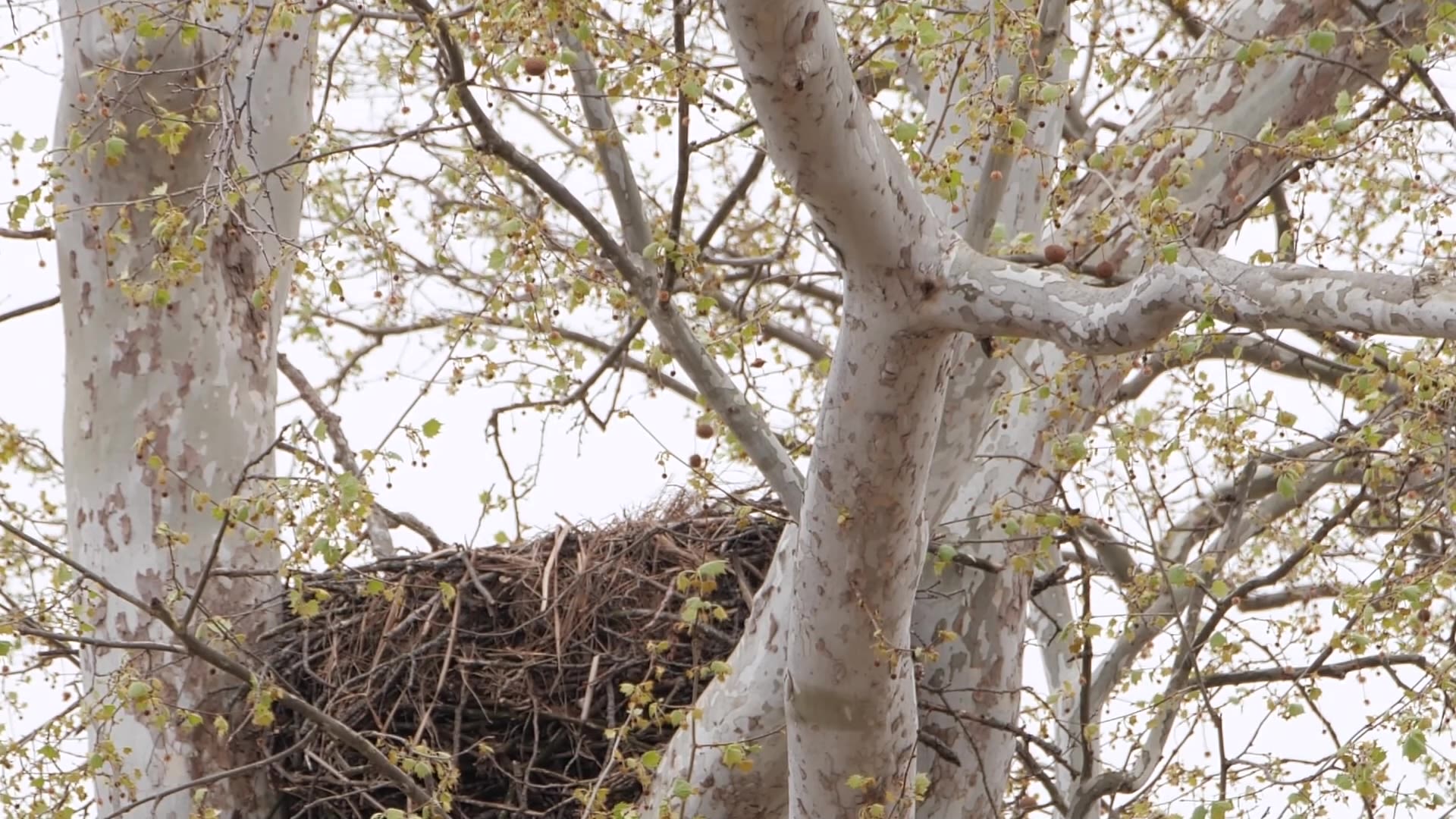
The eaglet located near the TJ Evans Trail still has some time to grow before it can leave the nest. Video by Doug Swift.
The eaglet located near the TJ Evans Trail still has some time to grow before it can leave the nest. Video by Doug Swift.
While early February through late April is typically the best window of time to view these nests, some nests will still be active in May. After eggs are laid, it takes 10 to 12 weeks for the young eaglets to fledge and leave the nest.
If you aren’t able to see the eagles this year, don’t fret. Bald eagle pairs have a pretty strong affinity to the same nesting area and will return year after year, Kearns said.
“We get nests that get blown out during wind storms, and oftentimes we find that the pair will rebuild the nest in the same tree if the tree is still there, or they’ll pick somewhere pretty close by.”
After fledging season, the eagles or eaglets might return to this nest, visible from TJ Evans Trail between Granville and Alexandria. Photo by Mia Fischel.
After fledging season, the eagles or eaglets might return to this nest, visible from TJ Evans Trail between Granville and Alexandria. Photo by Mia Fischel.
Mia Fischel writes for TheReportingProject.org, the nonprofit news organization of Denison University’s Journalism program, which is supported by generous donations from readers. Sign up for The Reporting Project newsletter here.
 Built with Shorthand